
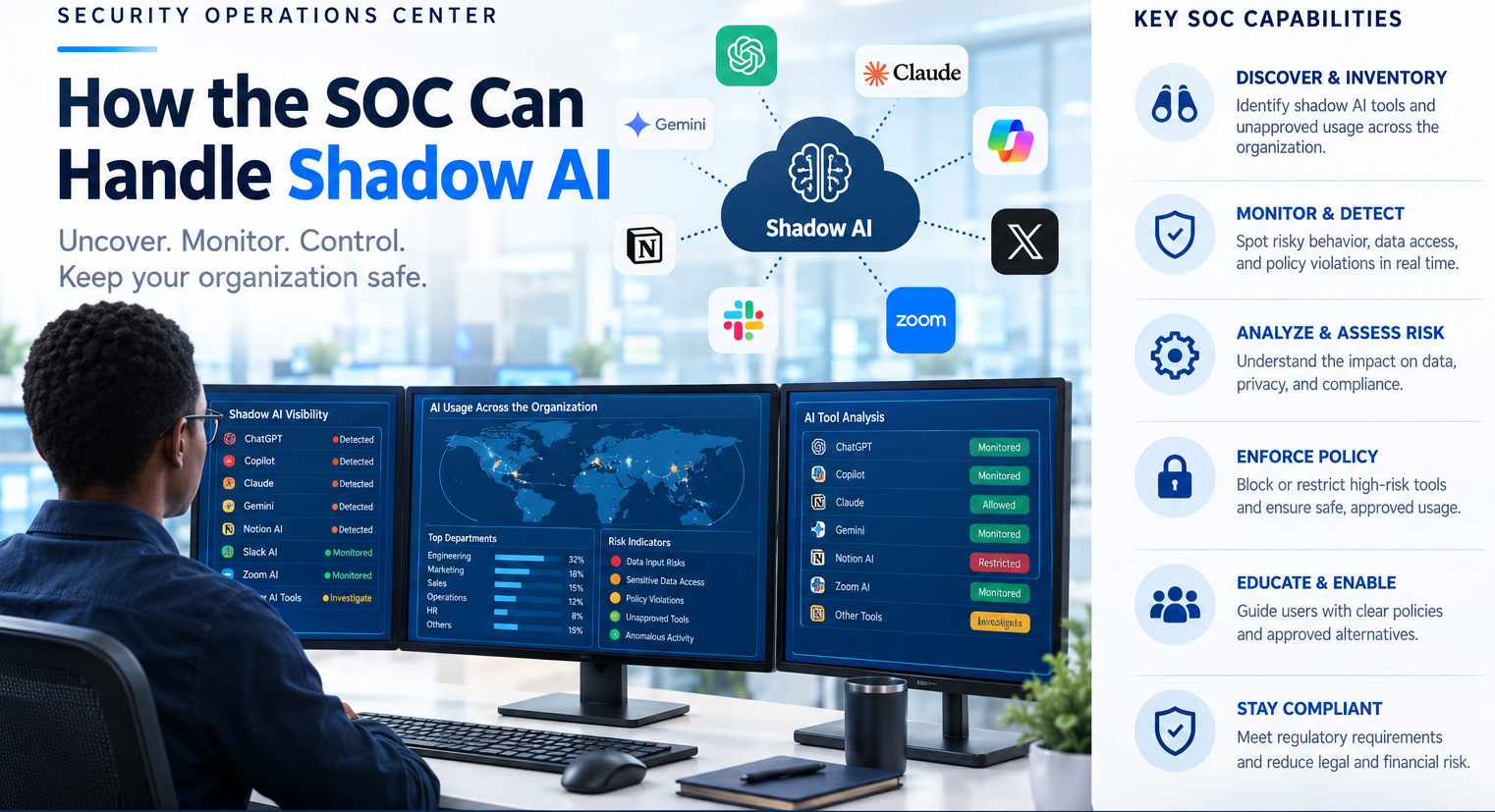
Artificial intelligence has rapidly become part of everyday business operations. Employees are using generative AI assistants to write code, summarize documents, analyze data, create presentations, troubleshoot technical problems, and automate repetitive tasks.
The challenge for security teams is that many of these AI tools are adopted without formal approval, security assessment, or integration into the organization's governance processes.
This phenomenon is commonly referred to as Shadow AI.
For the Security Operations Center (SOC), Shadow AI creates a new visibility, data-protection, identity, and threat-detection challenge. The objective should not simply be to block AI applications. Instead, the SOC needs the capability to discover, monitor, assess, and respond to unauthorized or risky AI usage while enabling legitimate business productivity.
What Is Shadow AI?
Shadow AI refers to the use of artificial intelligence applications, services, models, plugins, APIs, or automated AI agents without appropriate organizational authorization or security oversight.
Examples include employees using:
- Public generative AI chatbots
- AI coding assistants
- AI meeting transcription services
- AI document-analysis platforms
- Browser-based AI extensions
- Personal AI accounts for business activities
- Unapproved AI APIs
- AI-powered automation tools
- Autonomous AI agents
- Locally installed open-source models
Shadow AI becomes particularly concerning when employees submit organizational information to services that have not been evaluated by the security, privacy, legal, or compliance teams.
Why Shadow AI Matters to the SOC
Shadow AI introduces several security risks that traditional SOC monitoring may not adequately cover.
1. Data Exposure
Employees may unintentionally submit:
- Customer information
- Source code
- Credentials
- Internal documentation
- Financial information
- Security configurations
- Intellectual property
- Personally identifiable information
to an external AI service.
The SOC may have no visibility into what information was submitted.
2. Credential and Account Risks
AI applications frequently require authentication through:
- Corporate accounts
- OAuth
- API keys
- Service accounts
- Browser sessions
An employee connecting an unapproved AI application to corporate resources can potentially create a new pathway into the organization's environment.
OAuth permissions are particularly important.
An AI application requesting access to email, cloud storage, calendars, repositories, or collaboration platforms should be treated as a security event worth monitoring.
3. Malicious AI Applications
Not every application marketed as "AI-powered" is trustworthy.
Threat actors can create malicious applications designed to:
- Steal credentials
- Harvest OAuth tokens
- Deploy malware
- Exfiltrate data
- Collect browser information
- Establish persistence
- Trick users into installing malicious extensions
The SOC therefore needs to distinguish between AI usage and malicious activity involving AI applications.
4. AI Agents Create a New Attack Surface
Traditional AI applications generally wait for a user prompt.
AI agents can potentially:
- Read files
- Access email
- Execute code
- Call APIs
- Query databases
- Create tickets
- Modify cloud resources
- Interact with external systems
This changes the security model.
An AI agent with excessive permissions can become similar to a highly privileged automated identity.
The SOC should therefore treat AI agents as non-human identities with potentially significant privileges.
5. Shadow AI Creates a Visibility Problem
A major challenge is discovering AI usage in the first place.
Employees may access AI services through:
- Web browsers
- Mobile applications
- Desktop applications
- Browser extensions
- APIs
- Personal accounts
- Developer tools
- SaaS integrations
Traditional endpoint and network monitoring may identify the destination but provide little context about:
Who used the service, what they accessed, what data was transmitted, and whether the activity violated organizational policy.
Building a SOC Strategy for Shadow AI
The SOC should approach Shadow AI as a combination of asset discovery, identity monitoring, data protection, application security, detection engineering, and incident response.
A practical operating model can be built around seven capabilities.
1. Discover Shadow AI
The first step is understanding what AI applications are actually being used.
Potential sources include:
- DNS logs
- Secure Web Gateway logs
- Firewall logs
- Proxy logs
- CASB
- EDR
- Browser telemetry
- SaaS discovery
- Cloud access logs
- Identity provider logs
- Application inventories
Create an inventory containing:
|
Attribute |
Example |
|
AI Application |
AI service |
|
Domain |
example-ai.com |
|
User |
Employee/account |
|
Department |
Engineering |
|
Authentication |
Personal / Corporate |
|
Data Access |
None / Email / Files |
|
Risk Level |
Low / Medium / High |
|
Approval Status |
Approved / Unapproved |
|
Business Purpose |
Coding / Research / Writing |
"We think employees are using AI."
to:
"We know which AI services are being accessed, by whom, from where, and under what conditions."
2. Establish an AI Application Risk Classification
Not every AI application presents the same level of risk.
A simple classification model can help the SOC prioritize monitoring.
Low Risk
Examples:
- Public AI used for generic research
- No corporate authentication
- No sensitive data
- No integration with enterprise systems
Moderate Risk
Examples:
- Corporate account authentication
- Business information submitted
- Browser extension installed
- AI application connected to approved SaaS systems
High Risk
Examples:
- AI application accessing sensitive repositories
- AI agent with write privileges
- Personal AI account accessing corporate information
- Unknown AI application requesting OAuth permissions
- API keys associated with unauthorized AI services
- AI application accessing production infrastructure
Risk classification allows the SOC to focus its resources on the activities most likely to create security exposure.
3. Monitor AI-Related Identity Activity
Identity should be a major component of Shadow AI detection.
Monitor for:
- New OAuth grants
- New enterprise applications
- Unusual OAuth scopes
- Consent to high-risk permissions
- Service-account creation
- API-key creation
- Authentication from unfamiliar locations
- Impossible-travel events
- Unusual token activity
- Privileged account access
For example, an employee suddenly granting an unfamiliar AI application access to corporate email and cloud storage should generate additional scrutiny.
A useful SOC detection concept is:
New AI application + OAuth consent + high-risk permissions = elevated investigation priority
4. Monitor Data Movement
The SOC should work closely with DLP and security architecture teams to understand what data is being sent to AI services.
Potential controls include:
- DLP
- CASB
- Secure Web Gateway
- Endpoint DLP
- Email security
- Cloud access controls
Look for sensitive information being transmitted to unsanctioned AI destinations.
Examples of detection categories include:

The objective isn't necessarily to block every interaction.
The objective is to identify high-risk data movement.
5. Build Shadow AI Detection Rules
Detection engineering becomes particularly important as organizations adopt AI.
The SOC can create detections around several behavioral patterns.
Detection 1: New AI Application Access
Trigger when a user accesses an AI service that is not present in the organization's approved application inventory.
Signal sources:
- DNS
- Proxy
- SWG
- CASB
- EDR
Detection 2: High-Risk OAuth Grant
Trigger when an AI application receives access to sensitive enterprise resources.
Example:

This should be correlated with identity and application telemetry.
Detection 3: Sensitive Data Upload
Detect sensitive information being transmitted to an unapproved AI service.
Potential indicators include:
- PII
- Source code
- Credentials
- Financial data
- Proprietary documents
- Security configuration files
Detection 4: AI Agent with Excessive Privileges
Detect newly created AI agents or service identities receiving privileged access.
For example:

This should receive immediate security review.
6. Integrate AI Detections Into the SIEM
Shadow AI should not become another isolated security dashboard.
Relevant events should be integrated into the SOC's existing SIEM and XDR workflows.
A useful architecture might look like:

This allows AI-related activity to be correlated with existing security telemetry.
7. Develop an AI Incident Response Playbook
The SOC should define what happens when Shadow AI creates a security event.
A basic workflow could be:
Step 1: Detect
Identify unauthorized AI usage.
Step 2: Identify
Determine:
- User
- Device
- AI application
- Authentication method
- Data involved
- Permissions granted
Step 3: Assess
Determine whether:
- Sensitive data was exposed
- Credentials were compromised
- OAuth permissions were granted
- Malware was introduced
- Corporate systems were accessed
Step 4: Contain
Depending on severity:
- Revoke OAuth access
- Disable API keys
- Block the application
- Quarantine the endpoint
- Reset credentials
- Remove malicious extensions
- Restrict network access
Step 5: Investigate
Determine:
- What happened?
- What data was accessed?
- Was information transmitted externally?
- Was the activity intentional?
- Was the AI application compromised?
- Did the attacker obtain credentials?
Step 6: Recover
Restore normal access and remove unauthorized integrations.
Step 7: Learn
Update:
- Detection rules
- AI application inventory
- DLP policies
- Identity controls
- Security awareness training
- AI governance policies
Don't Make Blocking the Default Strategy
One of the biggest mistakes organizations can make is attempting to solve Shadow AI exclusively through blocking.
Employees often adopt AI because it solves real business problems.
If security blocks every AI application without providing approved alternatives, employees may simply find ways around the controls.
A better strategy is:
Discover → Assess → Govern → Monitor → Educate → Respond
rather than:
Discover → Block
The SOC's role should be to provide security visibility and detection while working with IT, legal, privacy, compliance, and business teams to establish appropriate controls.
Build an Approved AI Ecosystem
Organizations should establish an approved AI application catalog.
For example:
|
AI Service |
Status |
Authentication |
Data Classification |
SOC Monitoring |
|
Approved AI Platform |
Approved |
SSO |
Corporate Data |
Yes |
|
AI Coding Tool |
Approved |
SSO |
Source Code |
Yes |
|
Public AI Service |
Restricted |
Personal |
Public Data Only |
Yes |
|
Unknown AI Agent |
Blocked/Pending Review |
Unknown |
Prohibited |
High Priority |
This gives employees a secure alternative while providing the SOC with better visibility.
Shadow AI and Zero Trust
Shadow AI also fits naturally into a Zero Trust security model.
Instead of asking:
"Is this AI application trusted?"
ask:
"Should this user, device, application, and data interaction be trusted under these circumstances?"
Access decisions can consider:
- User identity
- Device health
- Application identity
- Data sensitivity
- Location
- Risk score
- Authentication strength
- Requested permissions
This is particularly important for AI agents that interact with enterprise systems.
Measuring Shadow AI Visibility
SOC leaders should establish metrics specifically for AI security.
Useful metrics include:
AI Discovery Coverage
Percentage of organizational AI usage that has been identified.
Approved AI Adoption
Percentage of business AI usage occurring through approved applications.
Unauthorized AI Usage
Number of detected unauthorized AI applications.
AI OAuth Risk
Number of AI applications with high-risk enterprise permissions.
Sensitive Data Exposure
Number of potentially sensitive-data transfers to unapproved AI services.
AI Detection Coverage
Percentage of defined AI-related attack scenarios covered by SOC detections.
Mean Time to Revoke
Average time required to remove unauthorized AI access or permissions.
These metrics provide a more meaningful picture than simply counting blocked AI websites.
The Future: Autonomous AI Agents
The next evolution of Shadow AI may be more difficult to manage than today's chatbot usage.
Organizations are increasingly experimenting with AI agents capable of taking actions rather than simply generating responses.
An agent could potentially:
- Receive an instruction.
- Read corporate data.
- Query internal systems.
- Execute an API call.
- Modify a record.
- Send an email.
- Trigger another automated workflow.
This creates a fundamentally different security problem.
The SOC will need to monitor not only human-to-AI interactions, but also:
AI-to-system interactions.
AI agents should therefore have:
- Unique identities
- Explicit ownership
- Defined permissions
- Limited privileges
- Auditable actions
- Credential protection
- Continuous monitoring
- Clearly defined business purpose
The principle of least privilege should apply to AI agents just as it does to human identities.
Final Thoughts
Shadow AI isn't simply an IT policy problem.
It is becoming a SOC visibility and detection problem.
Employees will continue to adopt AI because it provides real productivity benefits. Security teams therefore need to evolve beyond simply blocking AI services.
A mature SOC should be able to answer:
- What AI applications are being used?
- Who is using them?
- Which corporate accounts are connected?
- What permissions have been granted?
- What data is being sent to them?
- Which AI agents have access to enterprise systems?
- Can we detect malicious or unauthorized AI activity?
- Can we quickly revoke access when necessary?
The goal isn't to eliminate AI.
The goal is to make AI usage visible, governable, and defensible.
As AI becomes embedded into business processes, Shadow AI should be treated as a permanent component of the modern SOC's attack-surface and detection strategy.
The organizations that gain the most value from AI are those that can enable innovation without losing visibility and control.
Phelix Oluoch
Founder, PhelixCyber
W: PhelixCyber.com
